
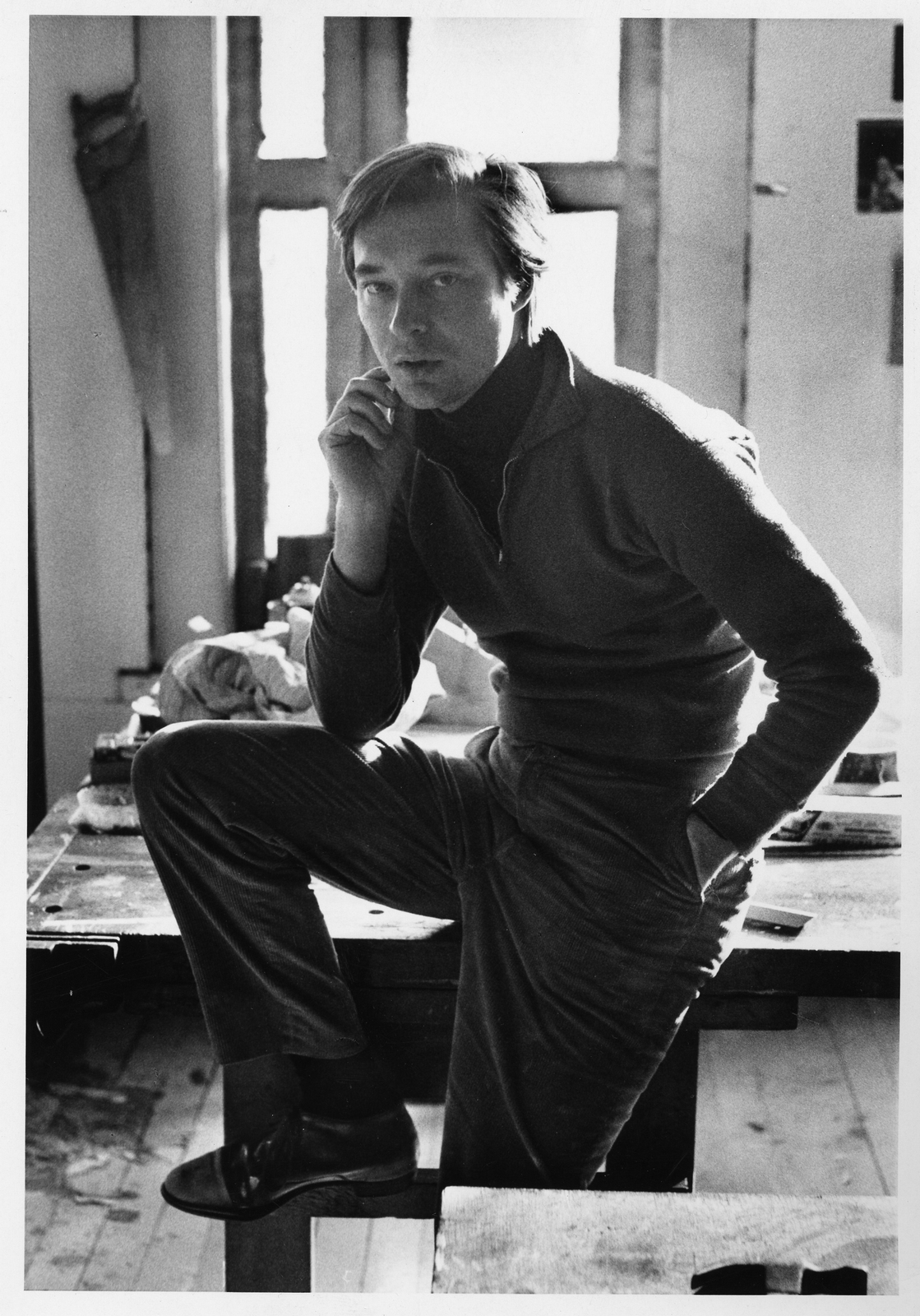
Garth Greenan Gallery is delighted to announce representation of the estate of Sven Lukin (1934–2022). A central figure in the 1960s New York art world, Lukin was a painter and draftsman whose brilliantly colored, audaciously three-dimensional work mounted a challenge to the era’s prevailing modernist orthodoxies. The gallery will present Lukin’s Tralfagar (1965) at its booth at Frieze LA.
Christened the “father of the shaped canvas” by the New York Times in 1968, Lukin wielded canvas, Styrofoam, and burlap-on-wood to create dramatic painting-sculpture hybrids that bulge and protrude into the real space of the gallery. Defined by their highly finished surfaces, immense curvilinear forms, and a bright, California-modernist palette, Lukin’s artworks are a testament to the myriad possibilities—and visceral power—of color, shape, and mass.
Born in Riga, Latvia, Lukin immigrated to the United States in 1948. After graduating high school, he enrolled in the architecture program at the University of Pennsylvania. There, Lukin encountered the work of influential architect and urban designer Louis Kahn, whose celebration of monumental scale, unadorned surfaces, and volumetric forms had a profound effect on the artist. After moving to New York in 1958, Lukin began to experiment with large, curved supports, occasionally bisecting these compositions with massive, unpainted wood beams. A trip to Venice, California, in 1963 inspired Lukin to shift his colors into a higher key: “All that sun, and all those oranges” he once remarked. “I had to paint in lush, bright colors.”
Lukin’s mature work of the mid-1960s is unmistakably corporeal: sinuous shapes unfurl on the gallery floor like tongues; volumes of solid color allude to lips or breasts; folded bands recall bent legs. Untitled (1969), an eleven-foot-tall, 120-foot-long wall painting at the Empire State Collection in Albany, New York, suggests a giant squiggle—or a coiled body gaining force and breaking free.
During the 1960s, Lukin had solo exhibitions at many of New York’s most influential and prestigious galleries, including: Betty Parsons Gallery (1961), Martha Jackson Gallery (1962), and the Pace Gallery (1963, 1964, 1966, and 1968). During this period, his work also figured prominently in many landmark museum exhibitions, such as The Quest and the Quarry (1961, Rome-New Art Foundation), Vormen van de Kleur (1964, Stedelijk Museum), The Shaped Canvas (1965, Solomon R. Guggenheim Museum), Color, Image, and Form (1967, Detroit Institute of Arts), Painting: Out from the Wall (1968, Des Moines Art Center), and L’art vivant aux États-Unis (1970, Fondation Maeght), among others. In 1972, at the height of his success, Lukin severed his ties with the Pace Gallery and refused to display his work in a commercial setting. His paintings were not seen again publicly until 1978, when the Los Angeles County Museum of Art mounted a solo exhibition of his work. In November 2010, a survey of the artist’s early work, Sven Lukin: Paintings, 1960–1971, opened at GARY SNYDER Project Space.
Lukin’s work is featured in the collections of major museums around the country, including: the Albright-Knox Art Gallery, the Los Angeles County Museum of Art, the Museum of Modern Art, and the Whitney Museum of American Art.
Image (right): Sven Lukin, c. 1965, in his studio on New York's Lower East Side.